Date: 27/10/2026
Read Time: 6 minutes
Author: Dr. Surani McCaw, B.E. (Chemical)
Many hospital RO systems that pass commissioning require major intervention or replacement within three to five years. These issues do not arise overnight. Dead legs, stagnant water zones, oversized storage, and poor hydraulic design allow deterioration to develop over months or years, with a failed sample often being the first visible sign.

Key points:
- Compliance shows the quality of water at the time of testing. Robustness is the system’s ability to keep achieving it throughout its service life.
- Long-term performance begins with fit-for-purpose design: microbial control, reliable disinfection, appropriate turnover, continuous monitoring and ease of maintenance.
- The cheapest compliant system often becomes the most expensive system to own and operate.
- Three actions help hospitals sustain compliance: review whether the system is still fit for purpose, focus monitoring on performance trends, and establish clear ownership with independent review by qualified professionals.
Reverse osmosis (RO) systems play a critical role in healthcare facilities, supplying water for applications such as sterile services, endoscope reprocessing, dialysis, and laboratory processes. While most systems achieve compliance during commissioning, many subsequently experience microbial deterioration, increasing maintenance demands, operational challenges, and, in some cases, premature replacement.
Across numerous healthcare facilities, these outcomes are observed regardless of manufacturer, contractor, or location. Although the circumstances may differ, the underlying causes are often remarkably similar.
Does Compliance Guarantee Long-Term Performance?

One of the most common misconceptions in healthcare water management is that a microbial excursion represents the failure itself. In reality, a failed microbiological result is often the first visible indication of a problem that has been developing within the system for months or even years.
By the time a failure is detected through routine sampling, the conditions that contributed to the deterioration may already be well established.
Deadlegs, stagnation, inadequate turnover rates, poor hydraulic design, insufficient monitoring, and ineffective operational visibility can all contribute to progressive microbial deterioration.
For this reason, compliance results should not be viewed in isolation. Understanding the design, operation, maintenance history, and long-term performance of a system is often far more valuable than focusing solely on a single laboratory report.
What Is the Difference Between Compliance and Robustness?
A system may successfully pass commissioning and continue to produce compliant water quality results during routine monitoring. However, neither outcome guarantees that the system is robust enough to sustain compliance throughout its intended service life.
Compliance demonstrates the quality of water produced at the time of testing. Robustness reflects the system’s ability to consistently achieve that outcome despite ageing infrastructure, changing operating conditions, maintenance activities, and unforeseen events.

The absence of microbiological excursions during the early years of operation should not automatically be interpreted as evidence of a robust design. Many systems continue to meet compliance requirements while underlying conditions that promote microbial deterioration gradually develop.
Deadlegs, stagnant water zones, low-turnover feedwater tanks, oversized storage volumes, inadequate disinfection capability, poor hydraulic design, insufficient monitoring points, and limited visibility of system performance can all contribute to progressive deterioration long before it becomes evident through routine sampling.
As deterioration progresses, hospitals may experience increasing operational challenges, escalating maintenance costs, recurring microbial issues, and significant remediation works. It is not uncommon for systems that successfully met commissioning requirements to require major intervention or replacement within only three to five years because the underlying design was never sufficiently robust to support long-term microbial control.
What Makes an RO System Design Fit for Purpose?
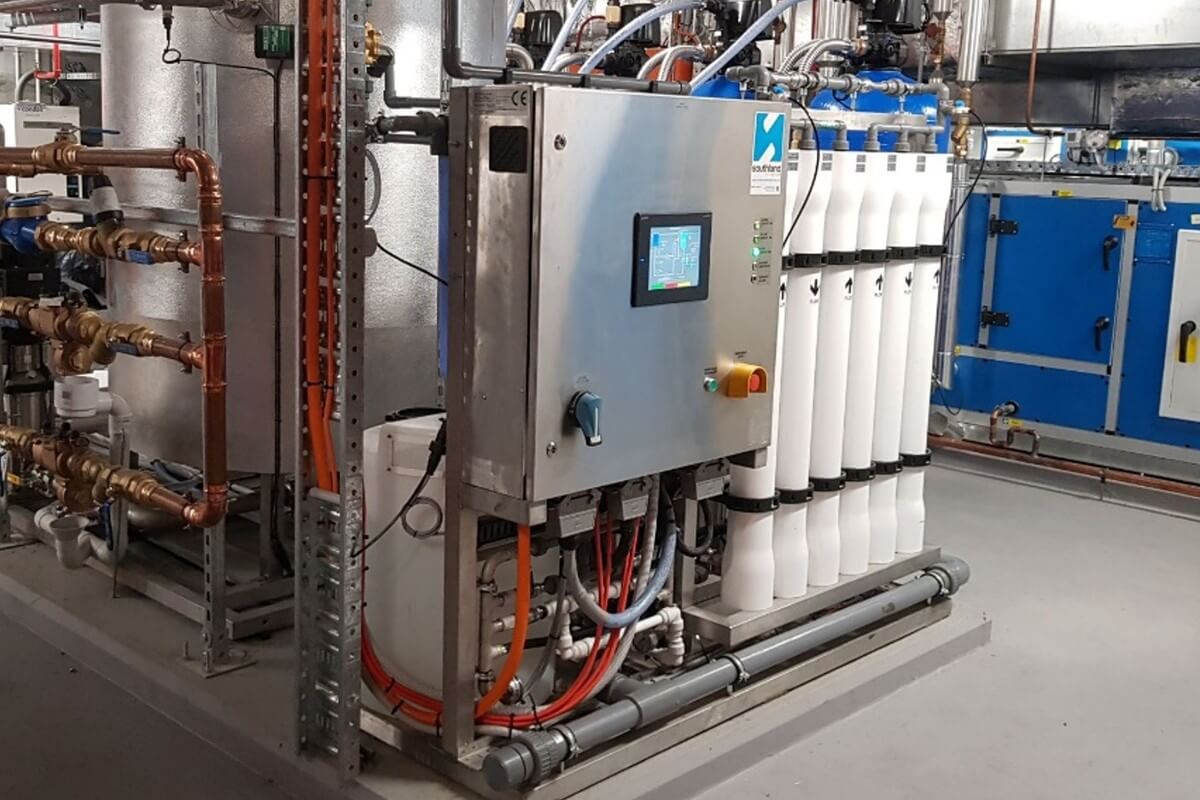
Long-term performance begins with fit-for-purpose design.
Healthcare RO systems should not only produce compliant water but also be designed for effective microbial control, reliable disinfection, appropriate turnover rates, dynamic process control, continuous monitoring, and ease of maintenance.
A system that lacks adequate instrumentation, monitoring capability, and automated process control is unlikely to remain compliant over the long term.A system that lacks adequate instrumentation, monitoring capability, and automated process control is unlikely to remain compliant over the long term. Likewise, systems that are difficult to maintain, monitor, or service increase the risk that deterioration will go unnoticed until compliance is affected.
Design decisions intended to improve a single compliance parameter can also introduce new operational risks. For example, a lower-cost solution such as deionisation (DI) resin may satisfy an immediate conductivity requirement while introducing additional operational considerations. Likewise, components intended to support disinfection may introduce increased process complexity and require careful design and control to avoid unintended consequences.
The most successful healthcare water systems balance compliance, reliability, maintainability, safety, operational practicality, and long-term asset performance.
Why Is Passing Commissioning Not Evidence of Long-Term Success?
Commissioning remains an essential part of any healthcare water project. However, commissioning provides only a snapshot of performance under specific conditions at a specific point in time.
The more important question is not whether a system passed commissioning, but whether it will still be delivering compliant water reliably and consistently ten years later.
Many systems do not fail because commissioning was performed poorly. They fail because commissioning was incorrectly treated as evidence of long-term success. A system can comply at handover while still containing design limitations or operational vulnerabilities that only become apparent over time.
The true measure of success is whether the system can continue delivering compliant water safely, reliably, and consistently throughout its intended service life.
Why Does the Cheapest System Often Become the Most Expensive?
Many projects understandably focus on achieving compliance at the lowest capital cost. However, the least expensive solution at procurement is not always the lowest-cost solution over the life of the asset.
Systems that lack the features necessary to support long-term microbial control may require increased monitoring, repeated disinfection activities, remedial works, higher maintenance expenditure, and, ultimately, premature replacement.
The true cost of an RO system should be measured across its entire lifecycle rather than at the point of purchase. In many cases, the cheapest compliant system ultimately becomes the most expensive system to own and operate.
What Role Do Governance and Independent Review Play?
Sustained compliance requires more than routine testing. It requires effective governance, trend analysis, and informed interpretation of performance data.
A compliant laboratory result should not automatically be interpreted as evidence of a healthy system, just as a failed result should not automatically be viewed as evidence of sudden failure. Both outcomes must be considered within the broader context of system design, operational history, maintenance activities, and long-term performance trends.
Organisations responsible for evaluating system performance should possess demonstrated expertise in healthcare water systems, microbiology, water treatment, and risk management. The objective is not simply to determine whether a test result passes or fails, but to understand what the data reveals about the condition of the system and the likelihood of future deterioration.
Independent review provides an important safeguard, as performance trends often reveal deterioration long before compliance limits are exceeded.
How Do Hospitals Achieve Long-Term Compliance?
Organisations that consistently achieve strong long-term outcomes tend to share several common characteristics. They invest in fit-for-purpose designs, utilise effective monitoring and data logging, review performance trends rather than isolated results, and establish strong governance frameworks with clear accountability and independent review.
A common characteristic of these organisations is a focus on visibility rather than reaction. They identify risks early and intervene before those risks develop into failures. They do not wait for microbial excursions to reveal underlying problems. Instead, they actively monitor and manage system performance throughout the asset lifecycle.
Most RO system failures do not begin with a failed sample. They begin with risks that nobody sees, nobody questions, and nobody owns.
For hospitals seeking to improve long-term outcomes, three actions are particularly valuable:
- Review whether the system remains fit for purpose today rather than relying solely on historical commissioning documentation.
- Strengthen monitoring and focus on performance trends rather than individual sample results.
- Establish clear ownership of long-term performance and ensure system performance is independently reviewed by suitably qualified professionals.
Together, these actions improve visibility of risk, support better decision-making, and reduce the likelihood of unexpected compliance failures.
What Does Sustained Compliance Depend On?
The healthcare industry has become highly effective at achieving compliance on commissioning day. The greater challenge is maintaining that performance throughout the life of the asset.
A compliant sample does not guarantee a healthy system, and a successful commissioning exercise does not guarantee long-term performance. Sustained compliance depends on the integration of fit-for-purpose design, effective monitoring, strong governance, competent independent review, and continuous visibility of risk.
Ultimately, the question is not whether an RO system is compliant today, but whether it is sufficiently robust to remain compliant, reliable, and fit for purpose throughout its intended service life.
Patients do not benefit from a system that was compliant five years ago. They benefit from a system that remains compliant today.

About the Author
Dr Surani McCaw is a Chemical Engineer who has been specialising in water treatment in the Healthcare and Pharmaceutical Industries since 2001. Surani holds a Bachelor of Engineering (Chemical) degree and a Doctor of Philosophy degree in water treatment from the University of NSW, Kensington, NSW.
Dr McCaw has been involved in the implementation of National Healthcare Standards/Practices for both CSSD and Renal Dialysis since 2008 with the intention of evaluating and implementing risk managed and cost-effective water treatment technologies that are fit for the Australian ecological and demographical environment.
Get in touch?
Talk to our team about your RO system’s water quality requirements. Call us at 1800 656 771 or email Andrew Cox – Sales Manager.





 Southland Filtration is a leading Australian provider of commercial water filtration solutions. We’ve been helping businesses since 1995 with a focus on quality, custom solutions, and reliable service. We work with businesses and organisations in Australia and New Zealand to address their unique water challenges and maintain the highest standards.