Date: 28/02/2026
Read Time: 5 minutes
Author: Dr. Surani McCaw, B.E. (Chemical)

Key points:
- Minimising water, energy, and space use at the source delivers the greatest impact.
- Poor design leads to higher costs, energy use, and maintenance—compromising sustainability goals.
- Discover how integrated water treatment solutions cut waste, improve compliance, and lower operational costs.
Sustainability Beyond Water: Energy and Space Considerations
In the current urgency to improve sustainability performance and meet environmental targets, initiatives focused on water reuse and recycling are becoming increasingly prominent. While these approaches have clear merit, sustainability must be viewed more holistically. It is not solely about reducing water consumption, it also includes energy efficiency and responsible use of space and infrastructure.
Achieving true sustainability requires a balanced approach, ensuring water recovery, energy efficiency, and effective use of space and infrastructure are optimised collectively rather than addressed in isolation.
It is useful to remind ourselves of the three key principles underpinning sustainability:

-
Reduce
-
Reuse
-
Recycle
The first principle, Reduce, is the most critical. If waste generation is minimised at the source, the subsequent need to reuse and recycle is inherently reduced. Applying this principle, it is the responsibility of water solution providers to design and manufacture systems that minimise water consumption, energy usage, and spatial requirements from the beginning.
Why Biofilm Risk Can’t Be Overlooked
Biofilm risk is often underestimated in sustainability-focused initiatives, yet it is frequently the point where sustainability objectives are compromised.
If a water treatment plant is designed in a way that promotes hydraulic imbalance, low-velocity zones, or lacks appropriate biofilm control mechanisms, microbial proliferation becomes inevitable. Under such conditions, increased cleaning, chemical dosing, energy consumption, and component replacement follow, ultimately undermining the objective to reduce resource consumption in the first place.
True sustainability is not achieved merely by recycling water, but by designing systems that remain microbiologically stable and operationally efficient throughout their full lifecycle.

Recycling and reusing water that has already been wasted requires additional capital investment to capture, store, and treat that water, along with ongoing operational and maintenance commitments to ensure reliable performance.
While water reuse delivers meaningful sustainability benefits, it requires careful planning and disciplined execution. Systems must meet appropriate water quality standards, mitigate biofilm formation risks, and comply with regulatory frameworks.
Learning from Industry Leaders
In an article authored by Andrew Cox, our Head of Sales, titled “Balancing Data Centre Growth with Water Responsibility,” he highlights how global leaders are incorporating the “Reduce” principle into their strategies.
For example, Google has pledged to advance responsible water stewardship across its operations and replenish 120% of its freshwater consumption by 2030. Its strategy prioritises reducing water use at the operational level through advanced technologies such as smart cooling systems and optimised water management before implementing replenishment initiatives.

Similarly, Microsoft approaches water reduction holistically across its business from operational efficiency improvements to long-term design innovation. The focus is on identifying immediate opportunities to reduce consumption while embedding strategies to reduce, recycle, and repurpose water through thoughtful system design.
These examples demonstrate that long-term sustainability leadership begins with reduction at the source, supported by strategic reuse and replenishment initiatives rather than relying on recycling alone.
Sustainability by Design
For healthcare facilities, achieving sustainability goals requires more than carbon offsetting alone. While we partner with leaders such as Tasman Environmental Markets (TEM) for carbon offset initiatives, our primary focus is on designing and manufacturing water treatment systems that minimise water consumption, energy use, and space requirements from the outset. By embedding sustainability into the design process rather than treating it as an afterthought, we ensure environmental responsibility aligns with operational efficiency, without compromising performance.
Transparency and accountability are fundamental to achieving meaningful sustainability outcomes. We prioritise demonstrable performance under full operational load to validate the commitments made during tendering.
System efficiency is confirmed through real-time monitoring of water and energy performance at the plant level, delivering measurable and defensible results. This enables facilities to confidently demonstrate compliance and operational excellence, without the risk of underperformance or the burden of justifying unmet expectations to end users.
Smart Design for Water Treatment Systems
We manufacture some of our products locally while also sourcing select products from overseas, collaborating with partners who share our commitment to sustainability. Our goal is to create systems that are efficient, durable, and use minimal resources to optimise water, energy, and space, while reducing their overall environmental impact throughout their lifecycle.
The performance of water treatment systems over their operational lifecycle is what truly matters. For example, our Herco HP5500D Series RO units are designed to minimise water, energy, and consumable waste through integrated, smart design. This ensures long-term efficiency and reliability for healthcare facilities. Key features include:
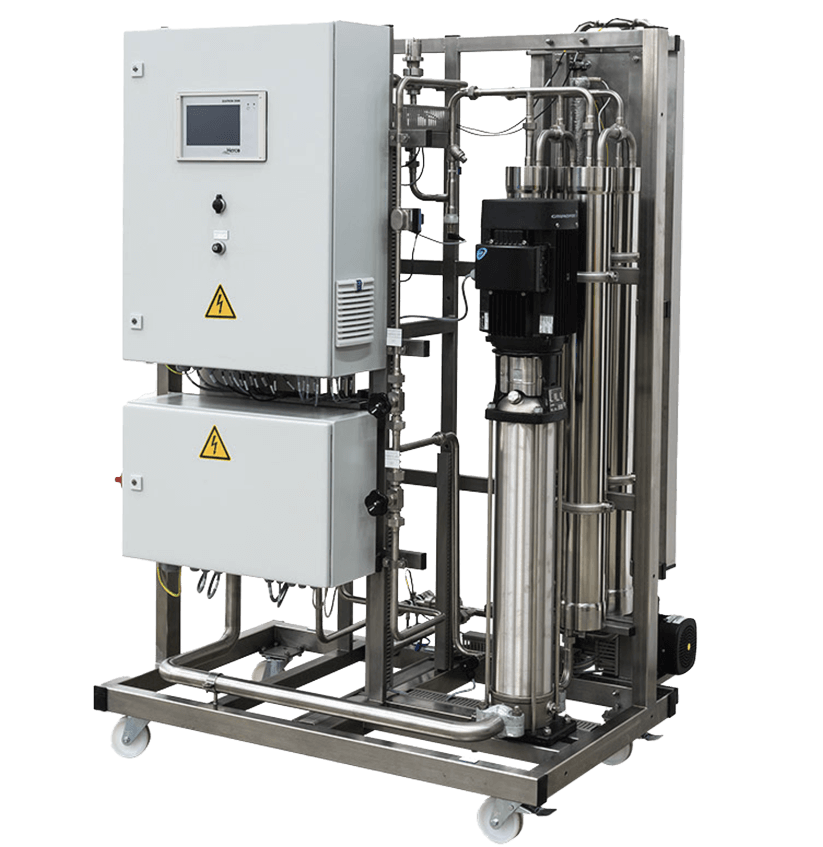
- Integrated feed water tank in two stage RO systems to enable conductivity measurement at the feed to the first RO unit. This allows reuse of most wastewater, enhancing efficiency and providing redundancy. Water recovery of 75 to 85% can be achieved.
- Rapid inline heaters instead of large storage tanks allow simultaneous disinfection of both the RO membranes and the ringmain. This approach reduces microbial “hot spots” (areas of stagnation where bacteria can accumulate), improves energy efficiency, and extends component life.
- Logic controlled A0 based disinfection for dialysis. Adequately sized heaters achieve A0 = 12,000 in just 20 minutes, minimising energy use and overall resource consumption.
- 4 inch RO membranes enhance performance, extend membrane life, and lower consumable costs compared to conventional 8 inch membranes.
These design principles reduce lifecycle resource consumption while maintaining high microbiological performance.
Supporting Pathology and Laboratory Needs
In pathology and laboratory environments, the Avidity Science range supports sustainability and reliability, helping facilities reduce waste and maintain compliance with water quality standards:
- Integrated pressure booster pumps achieving approximately 50% recovery, compared with typical 20–25% recovery in conventional systems.
- Membrane housings designed for retainable use, allowing replacement of membrane elements only and reducing plastic waste.
- Two-pass RO systems for high dissolved solids or high conductivity feed water, enabling direct feed to Type I systems and extending DI cartridge life to reduce consumable disposal.
- Semi-automatic chemical sanitisation to improve operational efficiency, extend equipment lifespan, and maintain water quality compliance.
- Integrated CO₂ degasser/scrubber to protect CEDI cells and DI filter performance, reducing consumable replacement and landfill impact.
Delivering Measurable Sustainability Outcomes
At Southland, we are committed to delivering water treatment solutions that are efficient, reliable, and environmentally responsible. Our systems are engineered to minimise water, energy, and consumable use while maintaining microbiologically stable, high-performance operation. By incorporating sustainability into every stage of design and operation, we provide measurable environmental benefits and support our clients’ operational objectives. We are a proudly Australian owned and operated company, offering products manufactured locally and through like-minded global partners, all designed to be environmentally sustainable and aligned with our ESG initiatives.

About the Author
Dr Surani McCaw is a Chemical Engineer with over 25 years of industrial experience, specialising in water treatment in the Healthcare and Pharmaceutical Industries. Surani holds a Bachelor of Engineering (Chemical) degree and a Doctor of Philosophy degree in water treatment from the University of NSW, Kensington, NSW.
Dr McCaw has been involved in the implementation of National Healthcare Standards/Practices for both CSSD and Renal Dialysis since 2008 with the intention of evaluating and implementing risk managed and cost-effective water treatment technologies that are fit for the Australian ecological and demographical environment.
Get in touch?
If you’re exploring more responsible ways to manage water in healthcare, let’s talk through your project and the design decisions that can make a real difference. Call us at 1800 656 771 or email Andrew Cox – Sales Manager



 Southland Filtration is a leading Australian provider of commercial water filtration solutions. We’ve been helping businesses since 1995 with a focus on quality, custom solutions, and reliable service. We work with businesses and organisations in Australia and New Zealand to address their unique water challenges and maintain the highest standards.